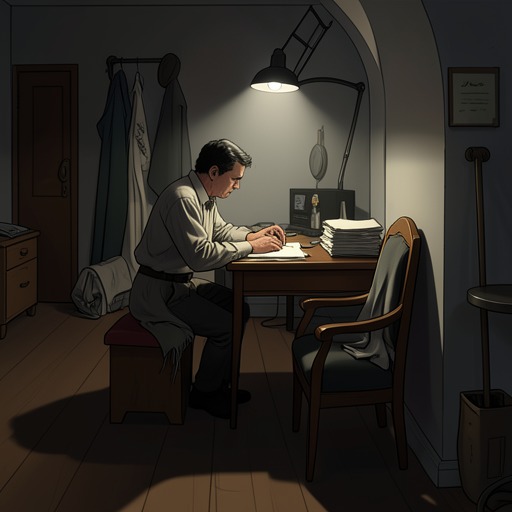
Éric learns of Bénédicte's death
L'Amour et les ForêtsÉric learns of Bénédicte Ombredanne's death by trying to resume contact and finding, instead, an online notice confirming that she died on January 23, 2011. The discovery joins an ordinary failed email and a search engine suggestion to the irreversible silence that had followed their correspondence: Éric realizes that the woman he had not answered was dead, and that his own withdrawal had become part of the story he could no longer repair.
The Attempt to Re-establish Contact
In March 2009, after several weeks without news from Bénédicte, Éric received an unexpected call from her. She sounded distressed and hurried. She asked that their relationship be suspended for a time and, above all, that he not send her text messages. Bénédicte explained that her husband had found a second phone hidden in her office bookcase, behind the collected works of Mallarmé. A quiet incoming-message alert had led him to the device. He read affectionate messages between her and another man, then reacted with rage and physical violence. Bénédicte told her husband that the messages were from Éric, intending to divert suspicion from the man she had recently met and protect him from her husband's attention.
The call makes the later search more than an attempt to renew a friendship. Bénédicte had once requested distance under immediate pressure, after her husband's discovery had intensified a pattern of surveillance and accusation. She had explained that he kept track of her movements through her schedule and expected her to return home after classes; after her affair, his questioning could recur throughout the day and wake her at night. Her request not to be contacted was a precaution in circumstances where even a message could expose her. Yet the silence that followed outlasted the immediate crisis. When Éric later tried to write again, he remembered that Bénédicte had forbidden him to use the number two years earlier and held back from sending a text.
The Search and the Notice
The renewed attempt began with an email. Éric wrote to Bénédicte at her former address, but the message came back undelivered: the address was reported as unknown or invalid. He then used his office landline to call the number he associated with her newer phone, ready to hang up if a man answered. The recording instead said that the number was out of service. He called her first phone as well and heard the same message. The two disconnected numbers left him with no direct route to her.
Éric turned to the internet and began entering Bénédicte's name into Google. Before he had finished typing it, the search suggestions supplied a phrase combining her name with the word death. He selected it and opened a memorial page reproducing a death notice published in Est Républicain. The notice gave the date of death as January 23, 2011, and named Condé-sur-Marne as the place of the religious ceremony, scheduled for January 28. The discovery came not through a message from a relative or an explanation of what had happened, but through a search result and a formal notice. A partial name entered into a search box became the route by which Éric learned that contact was no longer possible.
Shock and the Weight of Silence
The notice held Éric's attention for several minutes. He remained motionless at his computer, then began to cry. He wondered whether he had committed some grave error for such a terrible event to occur so close to his life, and whether replying to Bénédicte's birthday message a year earlier might have prevented her death, delayed it, or made its circumstances less painful. The question does not establish that a reply could have changed the outcome; it registers the helpless counterfactual into which the news throws him. The date and ceremony details are clear, but the notice offers no account of her final illness or death. For Éric, its spare public information is all at once proof and an inadequate substitute for knowing what happened.
The printed name of Bénédicte Ombredanne seemed to him like a name centered on a tombstone. The online notice functioned as an abstract substitute for a funeral: he could stare at the announcement, but it could not provide the presence, conversation, or farewell that the discovery made newly urgent. His response moves from bodily shock to tears and then to self-questioning. He does not simply grieve that Bénédicte is dead; he asks what his own earlier decision not to answer meant in the life that continued without him.
The Meaning of the Discovery
Éric interprets the two years of silence as connected but unequal. The first had fallen across their relationship through his own selfishness; the second, Bénédicte's death, had become irreversible. By trying to reopen the first silence, he discovers the second. Their coincidence makes the delayed attempt at contact a reversal: the message he hoped might restore a connection instead reveals that the possibility of reply has vanished.
His remorse is sharpened by his prior belief that Bénédicte would never leave her husband and would continue to endure his humiliations and psychological violence. That belief had not led him to remain present. After learning of her death, Éric asks why he had abandoned her when he thought he understood how trapped she was. The event therefore closes neither the history of her marriage nor the unanswered questions surrounding her death; it reveals the cost, for the surviving narrator, of a silence he had once treated as circumstantial. What had seemed an interval in a relationship becomes, in retrospect, the boundary between a missed chance to respond and a loss that cannot be answered.